
The first time you encounter a true Yirgacheffe, you don't just taste it. You question everything that came before it.
That was my experience in 2017, standing in a washing station outside the town of Kochere, watching a woman named Tigist rake drying coffee cherries across a raised bed in the thin morning air. I'd been in the coffee trade for nearly a decade. I thought I understood what coffee was.
I did not.
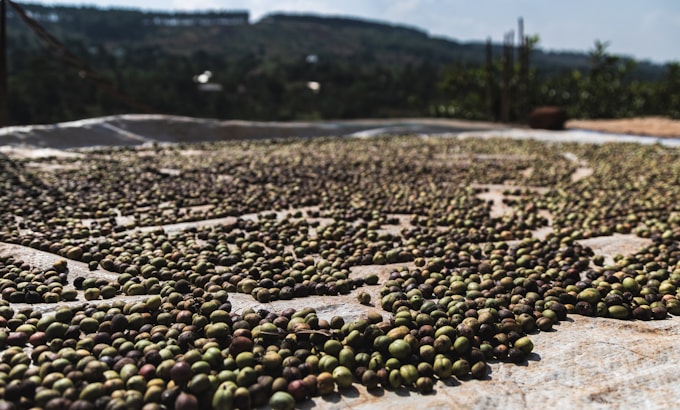
Yirgacheffe sits in Ethiopia's Gedeo Zone, at elevations that hover between 1,700 and 2,200 meters. The air is cool and dry in a way that feels borrowed from somewhere else — the landscape opens up above the treeline into something almost Alpine, punctuated by eucalyptus that colonists planted a century ago and that now grows wild over everything. You drive up from Awassa past markets selling injera and bundles of khat, up through the cloud layer, and when you arrive, the smell hits you before anything else. Green. Vegetal. Alive.
What Yirgacheffe does that no other region in the world consistently replicates is this: it makes jasmine and blueberry appear in a roasted bean. Not as descriptors invented by someone with a thesaurus. As actual, unmistakeable flavours that sit in the cup so clearly you half-expect to see petals floating in your mug.
The terroir here is ancient. Ethiopia is, by scientific consensus, where Coffea arabica originated as a wild plant. When you drink a Yirgacheffe, you are in some sense drinking the original coffee — the thing every other cup is a descendant of. The heirloom varieties growing on these hillsides have never been bred for yield or disease resistance. They have simply been grown, selected by altitude and rainfall and the hands of farmers who learned from their parents, who learned from theirs.
"Coffee is patience. Every cherry tells you when it is ready."
— Tigist Bekele, Kochere District
The Biru Bekele Natural we carry — Lot CL-25-ETH-03 — comes from a smallholder cooperative in the Kochere district that Tigist manages. Natural process means the cherries were dried whole on those raised beds, the fruit sugars fermenting slowly into the bean over three to six weeks. It is this process, combined with the altitude and the heirloom varietals, that gives the lot its particular character: a brightness that opens like a window, dark chocolate on the finish, and that jasmine note that arrives and then quietly refuses to leave.
We have been sourcing from this cooperative for three seasons. We visit every year. Every year we are embarrassed, again, by how good this coffee is, and grateful that Tigist still has patience for two Americans who take too many photographs and ask too many questions about processing times.
She has never rushed us. We try to remember that when we are at the drum.